It was a rainy morning of the month of August when I arrived in Nepal. The smallness of Kathmandu airport and the monkeys jumping everywhere in the waiting room welcomed me in the new and different world that was going to host me for the next ten months of my life. Ten months of European Voluntary Service in a local Ngo, a children’s home located in a rural village, one hour far from the capital city.
I had been looking for a volunteering project in the South of the world for months, or maybe for years, since my university’s time when, after an inspiring lesson of philosophy, I decided to write a thesis about the otherness and a professor answered me that the “other” is not a thesis, but a lifelong work. I chose another professor, but I wrote my thesis and I’ve cultivated my interest and curiosity about the other, the foreign, the alien.
You don’t need to go thousands kilometers far to meet the other, since other is anyone different from you, and you don’t need to move from your country to meet foreigners, because our cities are full of people coming from all over the world.
Nevertheless, leaving your home city and moving to another continent means jumping to the other side of the border; it means being yourself the foreigner, the white one, the alien, the one who can’t understand the local language, nor a signal or an advertisement, not even a dialogue among people surrounding you, the one standing in a line at the immigration office waiting for a visa. It means also getting used to a food your stomach refuses to digest, accepting that your landlord doesn’t want to kill the mouse hunting your house because he thinks mice are messengers of the god Ganesh, it means being teased by neighbors while trying to wash clothes by hands after 26 years of washing machine.
Though, being a foreigner in a non-familiar place is also a unique condition that wakes up your five sleeping senses from the lethargy of habits and makes you more than receptive to everything is happening around you. I clearly remember that the first days of my Nepali life, every day seemed so long, and not because I felt bored, but, on the contrary, because every hour was so full of new things to discover. Our body and our mind, when challenged by a new environment, seem to learn much more and faster than in the monotony of our daily routine.
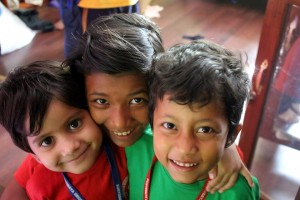
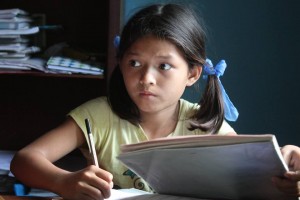
Day by day I started to understand what I had been told during the pre departure training. Leaving your home, your friends, your habits means leaving the safe and so-called “comfort zone” to enter in the more uncertain “challenging zone”. If you prevent yourself from falling in the “panic zone” – they told me – the “Challenging zone” will be for you a unique place for growing and learning. And so it is. Here I spend most of time with children: the 22 girls of the orphanage (who are like younger sisters to me), the 15 pupils of a class where I teach English and the 40 guys of another school where I teach moral education.
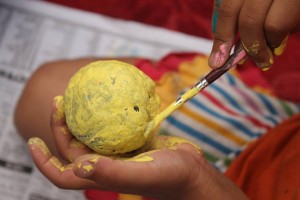
Except from some summer camps and few experiences of volunteering, I had never been a teacher or an educator before. I didn’t study for this job and probably I will not work in this field once back to Italy. So I found myself looking back at my childhood games, songs and handcraft working , mixing old memories and present influences coming from the people and the environment where I’m living. And maybe learning is just like this: a never ending work of recovering our past experiences and creatively reworking them with the new ones.
Starting from that, it is possible to understand how a travel to the opposite side of the world can make us (re) discovering our past and our identity.
Just an example stolen from one of my passion, cooking. One of the first days here in Nepal we bought –for the first and last time – a tomato sauce to cook pasta: it was as sweet as ketchup and not even salt or any aroma could change its bad taste. So I just thought about my Sicilian mom and granny, about the kilos of tomatoes and the smell fulfilling our kitchen, the red spots on the walls, the Bormioli’s jars closed and put under warm blankets to rest. I had never cooked tomato sauce before, but those memories, a strong desire of Italian pasta and a lack of a good sauce have made me an excellent cooker of tomato sauces.
Old memories and present needs, those needs that makes our brain sharper – as Manzoni wrote. And it is not just about food or other daily life necessities (like water, electricity and gas), but it involves also my volunteering activities.
I am thinking about the hour I spent teaching Moral Education in an intermediate class. This activity was not part of my original planning, but I came across it maybe by chance or maybe due to a long chain of causes and consequences. During my first meeting with the eccentric principal of the school, he asked me about my academic studies. As soon as I mentioned my degree in Philosophy, he thought about Moral Education. In the (short) list of possible jobs for people graduated in Philosophy, teaching Moral in Nepal have never been mentioned. Once again, an unpredictable possibility rooted in the past and born from a new context.
Moral Education is not a subject in the intermediate Italian classes and Moral Education taught in a Nepali school is far from the philosophy I studied at the university. Reading the book I realized that this subject consists mainly of fairy tales with the aim of teaching children how to behave in their family, at school and how to be good citizens of their country. It is just the practical side of what centuries of thinkers try to define as a good life.
Starting from this idea of practical philosophy, I let Nepal suggesting me a project to develop with the students. Mountains of waste at the corner of every streets, bonfires of rubbish, high level of air pollution and children throwing papers of chocolates and chips everywhere; that’s why I chose to work on an environmental project. I have never had any interest in ecology and I don’t know so much about global warming, greenhouse effect or carbon dioxide, but some researches on Google and the idea of a movie, Wall-E, gave birth to this activity.
Beyond the contents, I learnt how is important to work out a new method of teaching. In a country where learning is basically copy and memorize without understanding, I thought it was necessary to reverse the usual trend of a Nepali lesson: asking questions and making pupils think, instead of giving them answers.
I realize, by observing myself that I am living an experience of constant exchange between me and the world where I’m living. There is me – with my past, my passions, wishes and fears – and there is Nepal – with its landscape, people, culture, economical and social issues: we keep interacting with each other and just like a chemical reaction we keep producing something new, that can be known in its origin but not in its consequences. It is easy and fulfilling as cooking, you mix the topics and then you just wait for smells and flavors coming out from the oven.
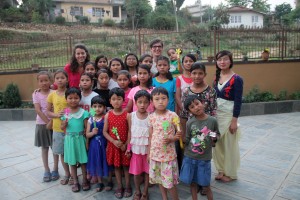
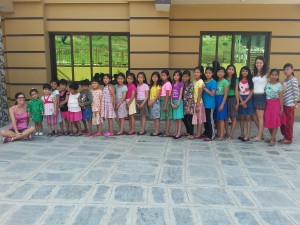
 Namaste! My name is Irene and I’m writing from Taukhel, a little village in Nepal, near Kathmandu. I have arrived in august, and I will stay here until the end of May. I work with Sara, another Italian volunteer, at the “Moonlight Children’s Home”, an orphanage, or better said, a big family with 22 beautiful girls. I help them during their daily activities: doing homework, going to school, serving lunch and dinner…but in particular I play with them and organize extra activities. Ever since the first day the children call us “sisters” because we are like older sisters for them. I like this job. When our children are at school we work as teachers in two different schools, teaching English and Morals. We are setting up an ecological project to teach them about pollution and how to preserve the environment. And last but not least, our activity is linked to fundraising; we write a monthly newsletter for our followers in which we speak about life in Nepal and send them pictures of the children. We also write posts on the Facebook page. This organization exists thanks to donations and we know that it is important to keep in touch with our supporters!